AI Glossary — Every Term Explained Simply
From Algorithm to Zero-shot Learning — every AI term explained in plain English, no PhD required.
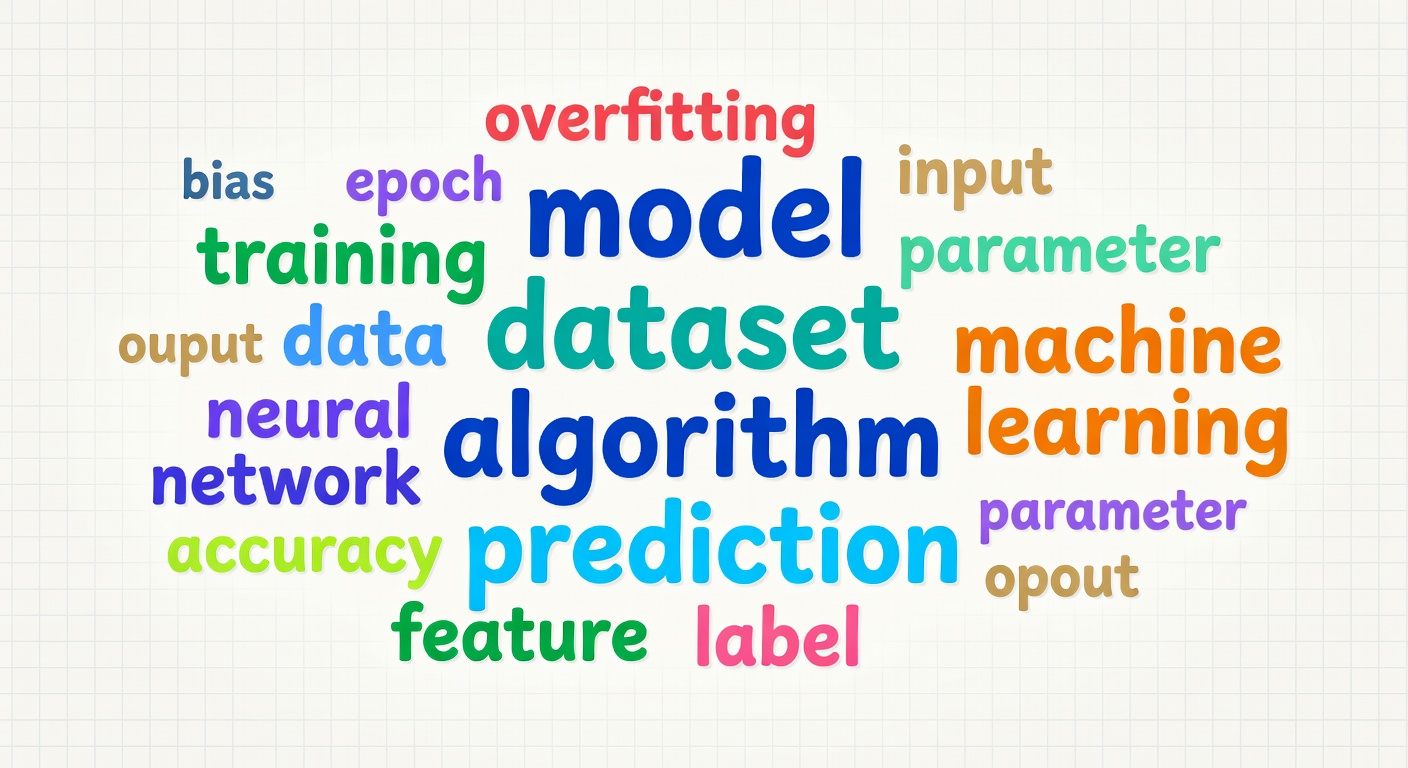
From Algorithm to Zero-shot Learning — every AI term explained in plain English, no PhD required.

Understanding AI terminology is the essential first step on your learning journey. When you know the language of AI, you can read news, research, and tutorials with confidence — and communicate clearly with AI tools, teams, and technologies around you.
Technical jargon is the biggest obstacle to learning AI. Our glossary removes that barrier entirely, making every concept accessible regardless of your background.
When you understand the vocabulary, tutorials and articles click instantly — cutting your learning curve in half and dramatically boosting your confidence.
Whether reading AI news, attending a workshop, or working with AI tools professionally, knowing the terminology puts you ahead of the curve.
Search or filter alphabetically to find any AI concept explained in plain English.
A set of rules or instructions that a computer follows to solve a problem or make a decision. AI algorithms learn from data to improve over time.
→ Learn moreThe simulation of human intelligence in machines, enabling them to perform tasks like reasoning, learning, and problem-solving.
→ Learn moreA system that can perform tasks independently without human intervention, often using AI for decision-making.
A computing model inspired by the human brain, consisting of layers of connected nodes that process and learn from data.
→ Learn moreA training algorithm for neural networks that adjusts weights by calculating the gradient of errors from output back to input layers.
Systematic errors in AI models caused by skewed training data, leading to unfair or inaccurate predictions.
Extremely large datasets that require special tools to process, often used to train AI models.
An automated software program that performs repetitive tasks, often powered by AI for more intelligent behavior.
An AI program designed to simulate human conversation through text or voice, used in customer service and education.
→ See use casesA machine learning task where the model assigns input data into predefined categories or classes.
An unsupervised learning technique that groups similar data points together without predefined labels.
An AI field that enables machines to interpret and understand visual information from images and videos.
→ See use casesA type of deep neural network specialized for processing grid-like data such as images.
The process of discovering patterns and knowledge from large amounts of data using statistical and AI techniques.
An interdisciplinary field combining statistics, programming, and domain expertise to extract insights from data.
A flowchart-like model used in machine learning where decisions are made based on feature values at each node.
A subset of machine learning using neural networks with many layers to learn complex patterns from large datasets.
→ Learn moreA structured collection of data used to train, validate, and test AI models.
Numerical representations of data (like words or images) in vector form, capturing semantic meaning for AI models.
One complete pass through the entire training dataset during model training.
The practice of designing and deploying AI systems that are fair, transparent, accountable, and beneficial to society.
→ Learn moreAn early form of AI that uses knowledge bases and rules to mimic the decision-making of a human expert.
The process of selecting, transforming, and creating input variables to improve machine learning model performance.
The process of further training a pre-trained model on a smaller, task-specific dataset.
A large AI model trained on broad data that can be adapted for many downstream tasks (e.g., GPT, BERT).
AI systems that can create new content — text, images, music, or code — based on patterns learned from training data.
→ Learn moreGenerative Pre-trained Transformer: a type of large language model by OpenAI that generates human-like text.
→ See tool reviewAn optimization algorithm used in training neural networks to minimize error by adjusting model weights.
When an AI model generates confidently stated but factually incorrect or made-up information.
Configuration settings set before training (like learning rate or number of layers) that control how a model learns.
The ability of AI to identify and classify objects, people, or scenes within images.
→ See use casesThe process of using a trained AI model to make predictions on new, unseen data.
A type of AI trained on massive text datasets that can understand and generate human language (e.g., ChatGPT, Claude).
→ Learn moreA statistical model used for binary classification problems, predicting the probability of a category.
A subset of AI where systems learn from data and improve performance without being explicitly programmed.
→ Learn moreThe process of feeding data to an AI algorithm so it can learn patterns and optimize its parameters.
AI systems that can process and generate multiple types of data — text, images, audio, and video together.
A branch of AI focused on enabling computers to understand, interpret, and generate human language.
→ Learn moreA computational model inspired by the brain, consisting of layers of connected nodes that learn from data.
→ Learn moreWhen a model learns the training data too well, including noise, and performs poorly on new, unseen data.
The process of adjusting model parameters to minimize error and maximize performance.
The practice of crafting effective input prompts to guide AI models toward desired outputs.
→ See tutorialsThe most popular programming language for AI and machine learning, known for its simplicity and rich library ecosystem.
→ See resourcesA type of ML where an agent learns by taking actions and receiving rewards or penalties from an environment.
A type of supervised learning that predicts continuous numeric values based on input features.
Machine learning where models are trained on labeled data with known input-output pairs.
→ Learn moreA learning approach using a small amount of labeled data combined with a large amount of unlabeled data.
A multi-dimensional array of numbers, the fundamental data structure used in deep learning frameworks like TensorFlow.
Reusing a pre-trained model for a new but related task, saving time and computational resources.
The dataset used to teach an AI model by exposing it to examples and their correct answers.
Machine learning where models find patterns in unlabeled data without predefined correct answers.
→ Learn moreA portion of data set aside during training to evaluate and tune model performance before final testing.
Numerical parameters in a neural network that are adjusted during training to minimize prediction errors.
The ability of an AI model to handle tasks or recognize categories it has never seen during training.
Don't see a term you're looking for? Help us grow the glossary by suggesting it below.